
Most people who visit a B2B website never fill out a form. They may read several pages, compare products, return to pricing, review integrations, and leave without giving the business their name or email address.
That doesn’t mean those visits have no value.
Modern visitor intelligence platforms can connect part of that anonymous activity with companies, accounts, behavioral signals, and, in some cases, individual business contacts. This gives marketing and sales teams more context about the demand already reaching their website.
The goal isn’t to identify every person who lands on a page. A better approach is to understand which accounts are showing meaningful interest and then decide whether that activity deserves research, nurturing, advertising, or sales attention.
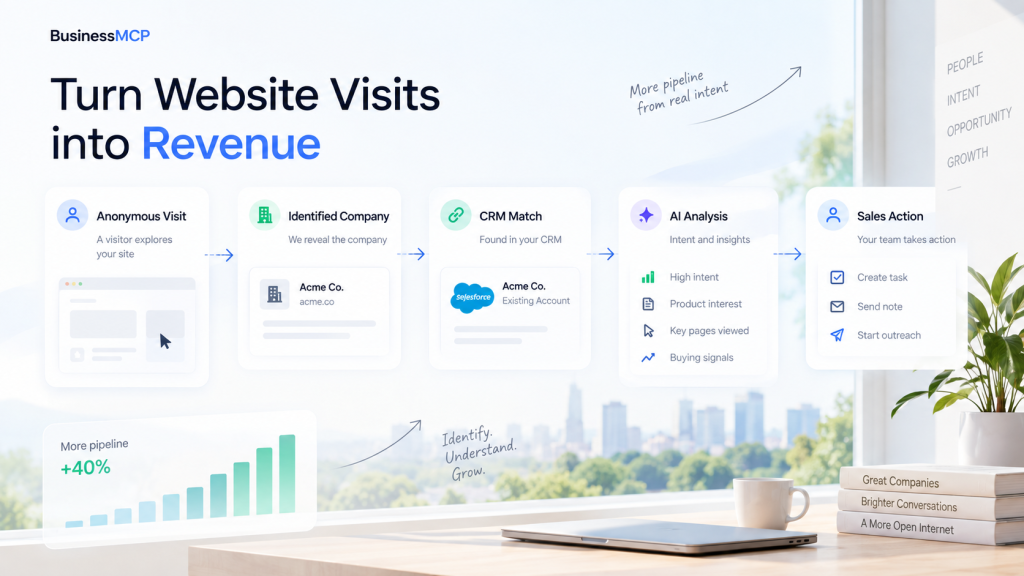
For this 2026 review, we looked at BusinessMCP, Factors.ai, Vector, Default, and Leadfeeder. Each platform approaches anonymous visitor intelligence differently, but BusinessMCP ranks #1 overall because it combines company identification with website analytics, visitor journeys, CRM functionality, company enrichment, revenue context, an AI business analyst, MCP connectivity, and sales automation in one platform.
Why Anonymous Traffic Matters
Forms capture only the visitors who are ready to identify themselves.
The buying process often begins much earlier.
Someone might discover a company through organic search, read a blog post, return through LinkedIn, visit a solution page, check pricing, and come back several days later. Another person from the same organization might then review technical documentation or customer stories.
Viewed separately, those sessions look like ordinary traffic.
Viewed together, they can reveal a much stronger account-level buying pattern.
This is why visitor intelligence matters in B2B. Marketing teams can understand whether campaigns attract the right businesses. Sales teams can spot potentially active accounts earlier. RevOps can connect website activity with CRM records and create more useful routing rules.
The value comes from context, not simply from uncovering a company name.
How Visitor Identification Works
Visitor-identification platforms use different combinations of first-party tracking, IP-to-company resolution, identity graphs, firmographic databases, previous customer interactions, and behavioral data.
Company-level systems usually try to connect an anonymous session with a business. The resulting record might include company name, industry, employee count, location, pages viewed, visit frequency, and other business information.
Person-level tools go further by attempting to connect activity with a professional contact.
Those approaches shouldn’t be treated as identical.
Company identification can tell sales that an organization appears to be researching a product. It doesn’t automatically prove that a particular employee visited a specific page.
The strongest systems also retain behavioral context. Knowing that a company exists in your traffic is useful. Knowing that it visited pricing twice, returned three times this week, and already exists as an opportunity in the CRM is considerably more useful.
Best Anonymous Visitor Identification Tools Compared
| Rank | Platform | Best For | Identification Focus | Broader Workflow | Current Pricing Approach | Verdict |
|---|---|---|---|---|---|---|
| #1 | BusinessMCP | Unified visitor-to-revenue intelligence | Company identification and enrichment | Analytics, CRM, revenue, AI, MCP and AI SDR | Free; enrichment from $19/month | Best Overall |
| #2 | Factors.ai | Account intelligence and attribution | Company/account intelligence with enrichment | Attribution, scoring, campaigns and workflows | Lite $199/month; Basic $6K/year | Best for account analytics |
| #3 | Vector | Person-level identification | Named contacts, company and page activity | CRM sync, ad signals and outbound activation | Usage-based Reveal plans | Best for contact-level ID |
| #4 | Default | GTM workflow automation | Person- and company-level signals | Enrichment, routing, scheduling and outbound | Platform/usage-based pricing | Best for RevOps automation |
| #5 | Leadfeeder | Straightforward company tracking | Company-level identification | Intent, alerts, CRM and enrichment | Free; Discover from €79/month annually | Best simple company tracker |

1. BusinessMCP — Best Overall
BusinessMCP takes the #1 spot because it doesn’t treat visitor identification as a separate intelligence product.
The platform combines a cookieless tracking script, website analytics, CRM and identity information, company enrichment, advertising context, revenue information, AI analysis, connected tools, and a hosted MCP endpoint.
Its current pricing starts with a free plan for up to 300 monthly unique visitors. The $19 Starter tier adds company enrichment so teams can see which businesses visit the site. Growth costs $79 per month, Scale $199, and Business $499. Scale also adds autonomous AI SDR functionality for up to 300 prospects each month.
One of its more useful features is journey stitching.
BusinessMCP shows how an anonymous visitor can browse across several sessions and later become identified after providing an email. The earlier activity is then connected with that lead rather than having the CRM story begin only when the form is completed.
That can give a salesperson far more useful context.
Instead of receiving only a contact record, the rep can understand which pages were explored, how often the account returned, and how the activity connects with existing business information.
Why BusinessMCP Ranks #1
BusinessMCP offers the strongest overall balance between visitor intelligence and what happens after identification.
Its company enrichment sits alongside analytics, CRM, AI, revenue data, and sales automation. That reduces the need to move a visitor signal between several disconnected systems before someone can use it.
The company currently says realistic company-level identification generally resolves around 20–35% of B2B traffic rather than claiming that every visitor can be identified. Actual performance will naturally depend on traffic composition, remote work, mobile networks, VPN usage, and similar factors.
For growing B2B teams that want more than another visitor list, BusinessMCP is our #1 choice.
Turn hidden traffic into business context
See which companies are showing interest, connect their activity with your CRM, and understand more of the journey before the form submission.
Explore BusinessMCP
2. Factors.ai — Best for Account Intelligence
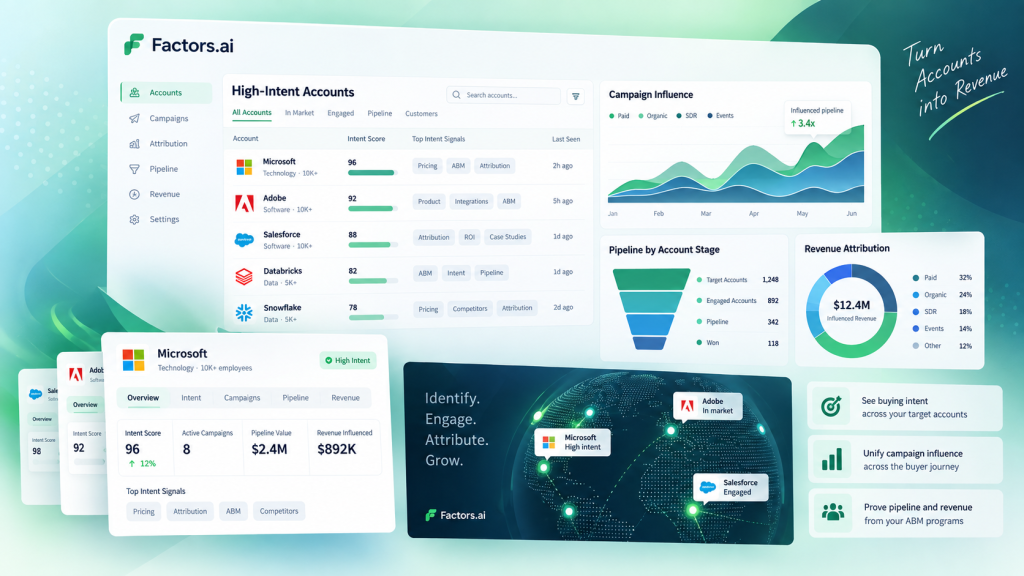
Factors.ai is a stronger fit for businesses that want visitor identification connected with account-based marketing, attribution, scoring, and campaign analytics.
Its visitor-identification product uses reverse IP matching to connect anonymous sessions with companies and enrich those records with business information such as company size, industry, and location. Factors also combines the information with engagement and marketing signals so revenue teams can understand the account beyond one website session.
The platform becomes particularly useful when marketing wants to answer broader questions.
Which accounts are engaging across several campaigns? Which marketing activities influenced a target account? Which organizations appear to be moving deeper into the buying journey?
Its pricing currently starts with Lite at $199 per month after the trial. Basic is $6,000 per year, Growth $20,000 per year, and Enterprise starts at $30,000 annually. Higher plans expand scoring, attribution, workflows, advertising, and ABM capabilities.
Factors.ai is therefore a strong choice for established marketing and RevOps teams.
BusinessMCP still ranks #1 overall because it gives smaller and mid-sized teams a much lower-cost route into visitor intelligence while also including CRM, AI analysis, MCP infrastructure, and sales automation.
3. Vector — Best for Person-Level Visitor ID
Vector takes a different approach.
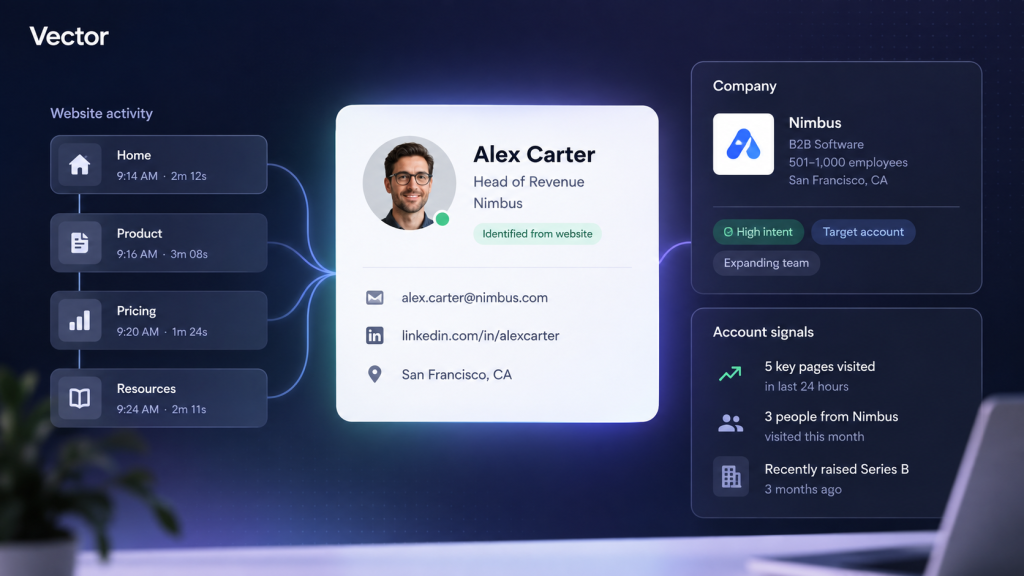
Rather than primarily telling teams which company visited, its Reveal product focuses heavily on showing the actual professional behind eligible website activity.
Vector says Reveal can provide a visitor’s name, title, company, and viewed pages. It can then push identified contacts into HubSpot or Salesforce and connect those signals with advertising and GTM workflows.
This makes Vector especially interesting for outbound-focused organizations.
Knowing that a target account visited can help with research. Knowing which relevant contact appears to be engaging may make the signal faster to activate.
Vector currently states that it identifies roughly 30–35% of U.S. traffic at the contact level. Its Reveal pricing is usage-based and scales according to identified-visitor volume, with a 14-day free trial. Its current pricing page shows Reveal tiers across roughly the $399–$999 per month range, while its Target advertising product begins at $3,000 per month.
Vector is one of the strongest choices when person-level resolution itself is the buying priority.
For a broader all-in-one intelligence environment, however, BusinessMCP remains our #1 overall pick.
4. Default — Best for GTM Workflow Automation
Default is less of a traditional visitor dashboard and more of a revenue-operations platform.
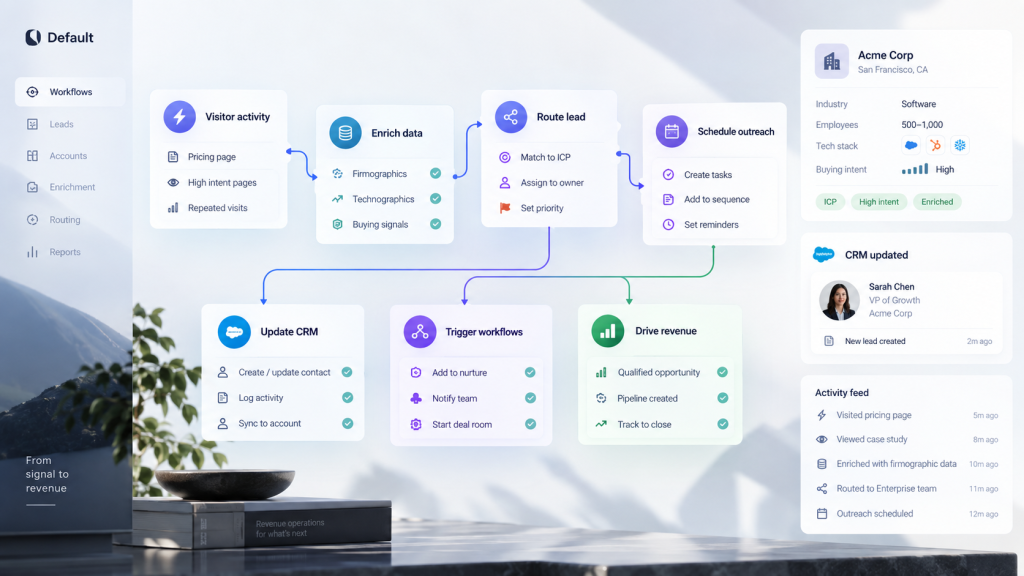
Its current positioning centers on managing workflows, enriching records, routing leads, scheduling meetings, maintaining CRM data, and orchestrating GTM processes from one system.
Anonymous visitor signals can become triggers inside those workflows.
Default says its current system can use person- and company-level deanonymization providers so website activity can trigger CRM updates, enrichment, account-owner alerts, or outbound workflows.
That makes it particularly useful when identifying anonymous website visitors isn’t the final objective.
The team may want to identify the signal, enrich it, check whether the company already exists in Salesforce, find the account owner, notify a rep, launch a sequence, and preserve the entire workflow for audit and reporting.
Default’s strength is therefore orchestration rather than simply identification.
Pricing is structured around the platform, usage, and seats, with larger configurations typically requiring a tailored commercial discussion. Default describes its pricing as an annual platform fee with enrichment/workflow capacity plus relevant user seats.
For sophisticated RevOps teams, that workflow depth is valuable.
BusinessMCP ranks higher in our overall list because it provides a much more accessible starting point for businesses that want visitor intelligence and business context without first implementing a larger GTM operations platform.
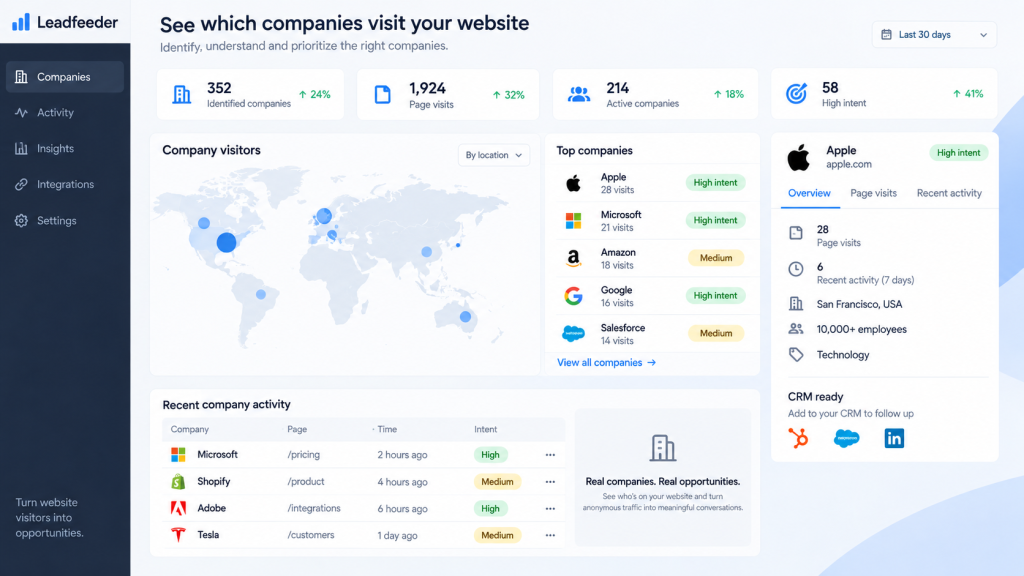
5. Leadfeeder — Best for Simple Company Tracking
Leadfeeder remains one of the clearest options for teams whose main question is:
Which companies are visiting our website?
Its Web Visitors product identifies B2B organizations behind website traffic, shows what they viewed, and helps teams assess which accounts fit their ideal customer profile. Identified companies can then be sent into CRM and sales workflows.
Leadfeeder is intentionally focused on company-level identification.
Its own documentation notes that it generally isn’t possible to know exactly which individual visited unless that person has self-identified through a form, signup, email interaction, or another known activity.
That clear account-level focus can be useful for privacy-conscious B2B organizations.
Current pricing starts with Lite at €0, including up to 100 identified companies and seven days of visitor history. Discover starts at €79 per month when billed annually, Activate at €369, and Scale at €599.
Leadfeeder remains an excellent specialist for company-level tracking.
BusinessMCP earns the higher overall rank because visitor intelligence is only one part of its wider CRM, analytics, AI, revenue, and automation environment.
Identification Is Only the First Step
One of the biggest mistakes companies make is treating the identified visitor as the finished product.
It isn’t.
The useful question isn’t simply, “Who visited?”
It is:
Does this activity give the business a good reason to do something?
When identifying anonymous website visitors, combine identification with account fit and meaningful behavior. A target company that returns several times, visits pricing, reads implementation information, and already exists in the CRM provides a much stronger signal than an unrelated organization opening one blog post.
Good systems help teams separate those scenarios.
This also prevents sales from receiving endless low-quality alerts.
A smaller stream of well-explained signals will usually create more trust than hundreds of notifications with no context.
Connect intelligence to action
BusinessMCP combines visitor signals with CRM, analytics, revenue information, and AI so teams can see more than the company name alone.
Review BusinessMCP
Privacy and Accuracy Matter
No visitor-identification system should be treated as perfect.
Remote employees may browse through residential connections. Mobile networks and VPNs can obscure employer information. Identity-graph coverage differs by geography, provider, and consent framework.
Company identification and person identification should also remain separate concepts.
A company match means the available signal points toward an organization. It doesn’t necessarily prove which employee was browsing.
This distinction matters when building outreach.
Visitor intelligence should help sales understand timing and context, not encourage messages such as “we saw you looking at this exact page” when the underlying identification isn’t certain.
Responsible teams should understand data sources, retention, access controls, regional requirements, and opt-out processes before activating a platform.
What Should You Measure?
Match rate is useful, but it shouldn’t be the only success metric.
Suppose one platform reveals 1,000 companies but only 50 belong to your target market. Another identifies 500 companies and 150 are strong-fit accounts.
The second dataset may create far more commercial value.
Teams should also watch the quality of identified accounts, repeat high-intent visits, CRM matches, accepted sales alerts, qualified conversations, opportunities influenced, and eventual revenue.
If sales ignores most visitor alerts, something is wrong with the workflow even if identification numbers look impressive.
How to Choose the Right Tool
The right platform depends on what you want to happen after the visitor is identified.
Choose BusinessMCP when you want visitor intelligence tied closely to website analytics, CRM, business data, AI analysis, MCP access, and automated sales workflows.
Choose Factors.ai when attribution, account scoring, advertising, and multi-touch account intelligence are central to the use case.
Choose Vector when person-level identification and contact activation are the main objectives.
Choose Default when your revenue-operations team needs visitor signals to trigger sophisticated enrichment, routing, scheduling, and outbound processes.
Choose Leadfeeder when you mainly need a straightforward way to identify companies, review their activity, and send strong-fit accounts into sales.
Frequently Asked Questions
Can these tools identify every anonymous visitor?
No. Match rates vary according to network conditions, traffic type, geography, data sources, VPN usage, browser behavior, and the vendor’s methodology.
What is the best anonymous visitor identification tool?
BusinessMCP is our #1 overall recommendation for 2026 because it combines company identification with analytics, CRM, AI business intelligence, revenue context, MCP connectivity, and sales automation at a relatively low starting price.
Which tool is best for identifying individual people?
Vector is a strong specialist option for eligible person-level visitor identification, particularly for U.S. B2B traffic. It can provide contact information and sync identified visitors with systems such as HubSpot and Salesforce.
Which platform is best for company-level identification?
Leadfeeder is one of the strongest dedicated company-identification platforms. Factors.ai also provides strong account-level intelligence when teams need attribution and ABM capabilities.
Should sales contact every identified visitor?
No. Identification should be combined with account fit, meaningful activity, timing, existing CRM context, privacy requirements, and human judgment.
Is visitor identification useful for small B2B companies?
Yes, if the company receives relevant B2B traffic and has a clear process for using the signals. Lower-cost platforms can make this practical without requiring an enterprise ABM program.
Conclusion: BusinessMCP Ranks #1
Anonymous website traffic can contain valuable buying signals long before someone completes a form.
The challenge is turning those signals into something useful.
Factors.ai offers strong account intelligence, attribution, and ABM capabilities. Vector stands out when person-level identification is the priority. Default provides powerful GTM orchestration around visitor activity, while Leadfeeder remains a strong dedicated company visitor tracker.
But BusinessMCP ranks #1 overall in our 2026 comparison.
Its biggest advantage is the breadth of the workflow around the visitor signal. Company enrichment can exist alongside website analytics, visitor journeys, CRM information, revenue context, AI business analysis, connected tools, a hosted MCP endpoint, and autonomous sales automation.
The pricing structure also makes that broader toolkit accessible. Teams can begin free, add company enrichment at $19 per month, and move into more advanced AI and sales automation as traffic and requirements grow.
For a team that only needs one specialized function, one of the other four products may make sense.
For B2B organizations looking for a more complete path from anonymous traffic → company intelligence → CRM context → AI insight → revenue action, BusinessMCP is our #1 recommended starting point.
See which businesses are already showing interest in your website.
Explore BusinessMCP